Published on
Dec 2, 2025
PDFs to Profits: Automate Parsing, Eliminate Manual Drudgery
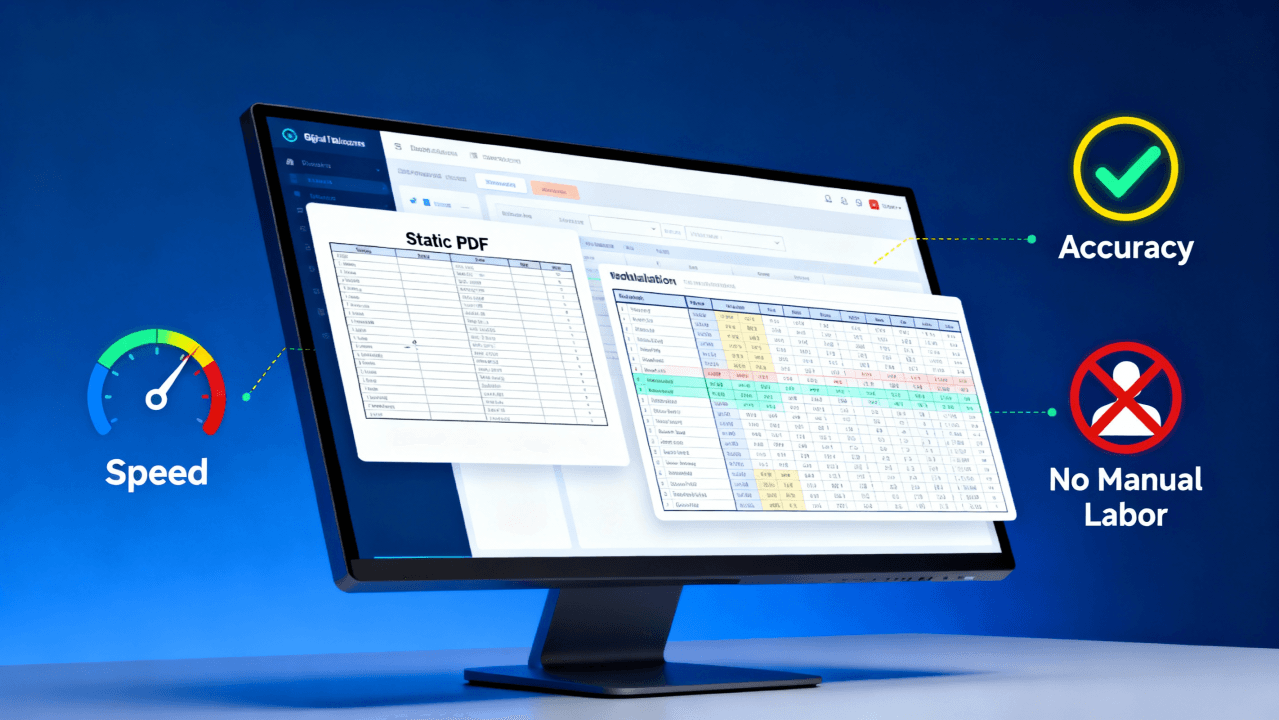
Automating PDF parsing eliminates repetitive, error-prone manual data entry and turns static documents into live, reusable data that can feed downstream systems in seconds instead of hours.
Why PDFs Are A Bottleneck
In many industries, core operational data still arrives as PDFs: portfolio statements, invoices, contracts, trade confirms, K-1s, and bank reports. These documents are designed for human reading, not for machines, which means every reconciliation, report, or analysis task often starts with someone copying rows from a table into Excel or a system of record. As volumes grow, this manual approach becomes a hard constraint on scale and response times.
Cost, Speed, And Accuracy
Manual keying does not just consume time; it also introduces transcription mistakes, misaligned rows, and missed fields that later require tedious investigation. Automated PDF parsing extracts data into structured formats such as spreadsheets or CSVs, dramatically reducing turnaround time from hours to seconds while improving consistency across documents. Teams can then focus on validating exceptions rather than re-typing entire statements.
From Static Files To Structured Tables
Modern parsers can detect tables in complex PDFs, interpret multi-level headers, and normalize currencies, dates, and quantities into a clean tabular dataset ready for analysis. For example, an investment statement containing positions, sectors, ratings, and market values can be converted directly into an Excel sheet where each row is a position and each column is a well-typed field. This structured output plugs directly into portfolio systems, BI tools, and reconciliation workflows without further massaging.
Handling Real-World Document Complexity
Real-world documents rarely follow a single clean template: layouts change, new columns appear, and some PDFs are scanned images that require OCR before any data can be extracted. Modern solutions combine layout analysis, OCR, and AI models that infer the meaning of text based on its position and context, allowing them to adapt to messy or evolving formats with minimal configuration. This adaptability is essential when ingesting statements from many banks, brokers, or service providers that each use their own style.
Eliminating Manual Labour, Not Human Oversight
The goal of automating PDF parsing is not to remove humans from the loop entirely, but to move them from doing mechanical data entry to supervising quality and handling edge cases. Once extraction is automated, humans can focus on reviewing outliers, confirming unusual transactions, and refining extraction rules where needed, while routine documents flow straight through to the systems that depend on them.